Did you know Pluto was discovered in Arizona? Yeah, we take it a little bit personally that poor Pluto has been demoted to dwarf planet.
Beyond the glowing light pollution of Phoenix, the mountain town of Flagstaff, Arizona has the perfect dark-sky environment for stargazing…and planet discovering.
Back in the early 1900s, when Great State 48 was still known as Arizona Territory and the Wild West was still in living memory, astronomer Percival Lowell built an observatory on a hilltop in Flagstaff. He spent the remainder of his life here, searching for the next great space discovery. First, he looked for canals on Mars that might prove the existence of water and life. When he didn’t find that, he searched instead for “Planet X,” a new planet he was sure existed at the edge of the solar system.
But it wasn’t until after Lowell’s death that Pluto made its dramatic debut into the world of astronomy. A Midwest farm boy and amateur space enthusiast named Clyde Tombaugh ended up discovering the planet after many cold nights of taking images on photo plates through the observatory’s cutting-edge telescope.
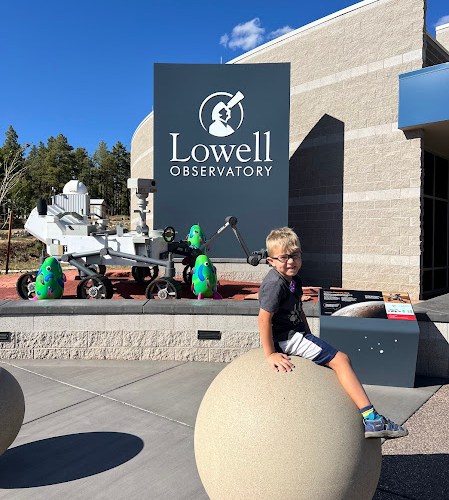
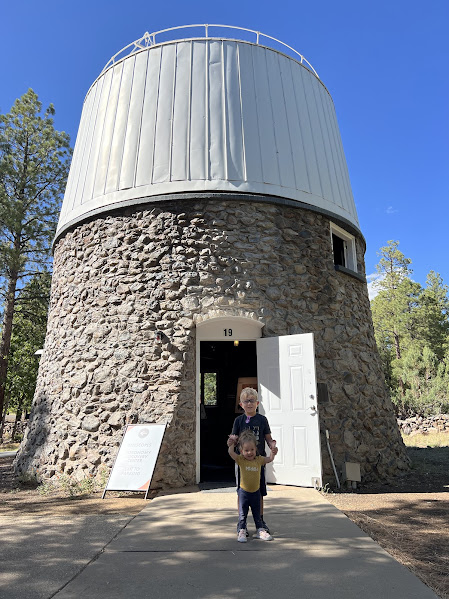
Visitors can still walk through the observatory to view the famous decades-old telescopes and the beautiful library of Percival Lowell. Recently, the museum has also added some fantastic displays and a children’s area to play and learn about astronomy.
We recently visited with friends, and everyone (ages 2, 4, 6, 12, 13, and two grown-ups) had an awesome time! If you’re ever passing through Flagstaff, be sure to take some time to stop and learn something new about space and Arizona history.
Could you ever find your name on those souvenir magnets or bicycle license plates? There are pros and cons to common names.
When my parents chose the name “Breana,” they were looking for something unique.
At the beginning of 1994, it was unique.
At the end of 1994, it was #27 on the lists of popular baby names. Of course, it was soundly beaten out by Jessica and Ashley (shoutout to all the Jessicas and Ashleys who had an initial tacked to the end of their name for their entire elementary school experience).
Of course, the spelling of my name helped me stand out a bit, even if there were a few Briannas and Breannas in my life growing up. And my maiden name is fairly unique.
Then I married a Johnson. Ha! Do you know how many Breana Johnsons there are on Facebook? Go ahead. Look it up. I promise you won’t find me.
However, as any good freelance writer would, I made sure to stay at the top of Google for my name despite its commonality. This worked for about eight years, until someone named Breana Johnson lit her boyfriend on fire.
Yup. That’s right. “Texas Woman Charged with Murder After Setting Boyfriend on Fire.” I’m not going to link it here, because I would like to eventually beat her in Google rankings again. And also because it’s a pretty disturbing story.
Someone told me I need to do something more memorable than human arson, which is good advice, but I’m not really sure how to follow that act. I am, however, open to suggestion that do not involve murder or fire.
Now I’m curious to know the top hit for your name. Google your name and tell me what you find in the comments!
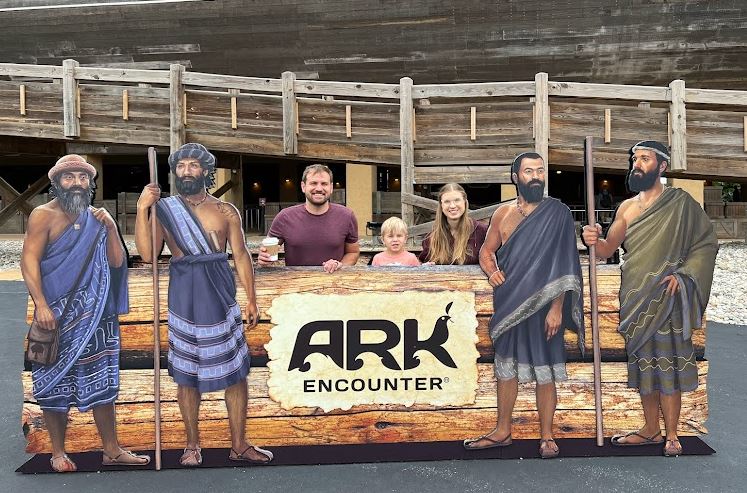
Have you ever wondered what Noah’s Ark really looked like? Well, travel to Kentucky (of all places), and you’ll get a pretty good idea. The Ark Encounter, a project of Answers in Genesis, is a life-sized ark based on the dimensions listed in the Bible.
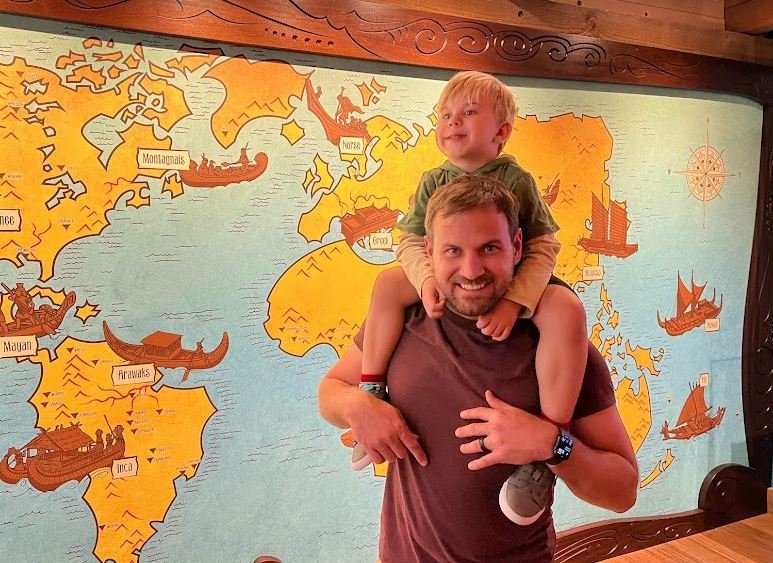
Using the theory that that each pair of animals represented one “kind,” they filled the ark with models of these creatures based on prehistoric fossils. There are also several displays within the ark, including an exhibit provided by the Bible Museum and one that shares flood legends around the world.
It’s a little bit museum and a little bit theme park, which appealed to my five-year-old who loves science. Our visit to the Ark Encounter was an awesome experience for our whole family, from my parents (who brought us!) to my kids.
Judging by the major crowds at the Ark on the Saturday we visited, this is a popular destination. Perhaps this is, in part, because children’s tickets are free. The venue also hosts conferences and concerts–the day we visited, there was live music by a well-known Christian band included with the price of a ticket. We didn’t attend because there was so much to see!
Definitely a fun trip and one I’ll repeat when my kids get older and mature enough to appreciate new things about the experience.
But I have yet to share the process from start to finish. Here’s what it takes for someone to travel from high school student to doctor.
High School in Kenya: Discovering His Calling
Ben’s interest in medicine started when he nearly died of spinal meningitis in Kenya during high school.
After graduating high school, Ben flew to the States with two bags and a couple hundred dollars in his pocket. He started college at Arizona Christian University.
As you may have noticed if you follow me on Instagram, I’ve been spending as much time as possible in and around the Superstition Wilderness this year! I love that area– the history and mystery, the natural landscape.
When I’m outside, I like to know the names of the plants I’m seeing and what they can be used for. Ben would probably like it if I would stop eating things I find in the wild, but if the apocalypse comes, I’ll be one of the few who knows how to prepare mesquite pods 😉
Boyce Thompson Arboretum
I’ve been doing a lot of plant research online, but it’s just not the same as getting out and learning about plants in person. So, for my birthday excursion, we headed to Boyce Thompson Arboretum, a huge garden of desert landscapes complete with hiking trail!
The arboretum is located at the foot of Picketpost Mountain (or, Piglet Wiglet Mountain, as my three-year-old has dubbed it), a formidable peak that is not possible to summit with a child and a dog. And yes, I know that from experience.
A natural stream runs through the gardens, bringing life to the desert landscape. However, you won’t just find Arizona’s flora here–there are also exhibits from desert environments all over the world!
Boojum trees are named after a word Lewis Carroll invented for The Hunting of the Snark
Why visit Boyce Thompson Arboretum?
If you’re in the East Valley region of the Phoenix Metro Area, the arboretum isn’t too far of a drive out of town. And it’s definitely worth it! Those who enjoy the Desert Botanical Gardens in Phoenix will love a getting a different angle on local vegetation.
Boyce Thompson Arboretum is a great activity for people of all ages and mobility levels. While not all the trails, including the loop trail, are accessible, you can see most of the gardens from paved paths.
Little ones will love the kid appeal in the children’s garden. It provides an opportunity to talk about shapes and colors.
Where’s your favorite place to explore the natural world? Do you like arboretums or just getting out in nature? Leave a comment and let me know!
There’s so much you can eat and make from things that grow in the desert! It’s a common misconception that the desert is just a barren place full of thorns and poisonous things. But as a tour guide at the Casa Grand ruins once pointed out, it’s like living in a grocery store. I’ve done my fair share of eating desert plants, but did you know you can make a lot of things from them, too? Even if you have no experience with bushcrafting or textile arts, you can create this yucca coil basket.
I have a yucca in the front yard that I’ve hardly thought about since we moved in. Why did I decide to cut off a couple of leaves today and make a basket? It’s all a part of my writing research for the novel I’m working on. My book is a survival story set in the Arizona desert, and my main character is an ancestral crafts instructor. So I figured I’d better learn some ancestral crafts. After all, it’s a lot easier to write about something when you’ve experienced it, not just watched some YouTube videos!
Yucca stalk
This isn’t the first time I’ve done hands-on research for the writing. Obviously, my travel writing for the web is experience-based. As far as fiction goes, I’ve also had the chance to fly a plane and learned to make mud bricks!
Drop a comment if you’d like to see an instructional post on how to make mudbricks in your backyard.
Pressing mud into a mold
Bricks drying
Mixing up mud!
So, on to why you clicked on this link: how to make a yucca fiber coil basket.
Harvest Yucca Leaves
There are a lot of ways to make a basket out of yucca leaves. I picked this one because I already knew how to make coil baskets. To date, my attempts at other types of basket weaving have not gone so well.
The first thing to do is cut a couple of yucca leaves! I took two to make this basket. It was really tiny. Like an Easter basket for a Barbie doll. If you want it to be bigger than that, you’ll need a lot more leaves. I didn’t want my yucca to be bald, so I stuck with a small project.
Be careful cutting yucca. There are sharp and some varieties have teeth on the edge of the leaves.
Scrape
You’ll need a couple of rocks for this. One should be large and flat, the other should be smaller and have a sharp edge, ideally. Scrape all the wet green stuff off the yucca leaf.
You are not pounding. I found this out the hard way. Scraping is a lot more effective. I tried rinsing out some of the green mush, and it worked OK, but it will dry just fine if you scrape it best you can.
Separate the fibers. There should be a few fibers to a strand.
Cord
Now you’ll need to create a cord out of the fibers. I was daunted by this part, thinking of Pa Ingalls in Little House on the Prairie cording straw until his hands bled by the fire all winter.
It’s not like that.
Cording was surprisingly easy, although a slow process. Basically, you have two strands of fibers. You give the bottom one a clockwise twist and then bring it counter-clockwise to the top and repeat, twisting in new strands as you get to the bottom of each.
If that makes no sense to you, try watching this video on yucca cording.
Coil
To make a coil basket, you need your cord and you also need a thicker strand to act as a base. Put your cord through a tapestry needle (or get really epic, and make a needle out of the point of the yucca leaf) and begin to wrap the thick strand with the cord.
Wrap it tightly until you have enough length to overlap in a small circle, then wrap over the overlap to secure the loop. From there, continue to wrap along the length of the thicker cord a dozen or so times, then insert the needle below the row under your current row to secure it.
Continue until you run out of cord. Now secure the end, tie off, and weave in ends.
For visual instructions, try watching this video on coil baskets.
You did it!
And that’s a wrap!
Get it? A wrap?
Anyway, I hope you have as much fun as I did making your own basket! If you’re the expert on this and have any advice on how to do this better, please leave a comment! I’m looking forward to learning more bushcraft skills as I do research for my novel. Stay tuned for more desert survival ideas!
When you get an invitation to go up in a prop plane, you take it.
I recently finished writing a novel manuscript that involves a character making an emergency landing in a small plane. And that’s all I’m going to tell you about it for now—sign up for my newsletter in the sidebar if you want to hear more in the future!
Thanks to the flight elements in my novel, I watched a lot of Youtube and read a lot of content on how to fly a plane.
Turns out, all those buttons and the names of various parts of airplanes are kind of hard to get a handle on when you’re just piddling around online.
So, I wrote the scenes as well as I could and then reached out to John Correia, one of my professors from college who also happens to have his pilot’s license, to see if he’d look it over and make sure I had it right.
Sure, he said. I could do that. Or, I could take you flying.
Um, yes please.
To say I was excited would be a major understatement. I’ve been on a lot of commercial jets, but never in a small aircraft.
The weather was perfect on the day of the flight. I pulled into the parking lot of Flying Cacti at the Glendale Airport and looked around. Not only had I never been on a smaller plane, I’ve never been in a hangar. Actually, I think I might have been in one at Luke’s Airforce Base when I was a kid on a field trip. Obviously I don’t remember enough of that for it to count, though.
Before Takeoff
John opened the hangar door to reveal a blue and white Van’s RV12. Wow! I couldn’t help but run my fingers over the glossy exterior. I could already tell that the glass dome covering the cabin was going to give incredible views, and propeller on the nose just begged to take us for a spin.
John whipped out a checklist to show me all the things he had to check before taking the plane up. It was a long list. As he pointed out, if something goes wrong with your car, you pull over. If something goes wrong with the plane, you fall out of the sky. I had been a little bit nervous at the idea of being way up in the air in a small aircraft, but after seeing how thoroughly everything had to be checked, the trace of nerves I had vanished.
During this process, it was cool to get to ask questions about how the plane worked and what every little thing did. For example, the static ports, two tiny pinholes in what looked to me like screws, use air pressure to give the pilot information about speed and altitude. I never cease to be amazed by engineers and their ability to create and pay attention to all the details. Or to create a flying machine that can carry two people and only weighs about 800 pounds.
Once all the checks were done, John pulled the plane out of the hangar and we climbed in. For my book, I needed to know the steps to start the plane and taxi down the runway, so he talked through everything as he went. When the propeller started whirring into a blur, I could feel it pushing air right into the cabin through the vents that serve as air conditioning.
My heart started beating a little faster. I was in real prop plane, about to go up in the air!
Flying!
John taxied down the runway. We waited for a couple of other planes to take off, and then he powered the plane forward, lifted the nose, and suddenly we were up in the air. Just like that. I felt a huge smile stretching across my face. Wow, the views were way better than they are in a jet with the giant wing slicing through my view out the tiny window. I could see the whole dome of sky above and the earth rapidly falling away below.
We flew above Phoenix Raceway, over the top of the Estrella Mountains, and into farm country I didn’t even know existed behind the mountain range. Below us, brown pinpricks wandered around—cows grazing in the sunshine. The Gila River snaked through the region, feeding the various canals that turn the landscape green despite the desert beige that stretches in all directions beyond the Phoenix area.
In the Air
Since the episode in my story involves a non-towered airport, John took me to Buckeye Airport for a touch-and-go landing, meaning the plane landed on the runway and took off again without stopping. I got to hear all the pilots talking to each other through my headset, communicating in the absence of a tower to coordinate landings and takeoffs.
It’s kind of hard to understand all the different voices through the headsets, which is why pilots use the NATO phonetic alphabet to reduce avoid confusion when they communicate. It sounds like some sort of secret code. Charlie Oscar Oscar Lima!
I had a lot of questions I wanted to ask about the way prop planes work, what would happen if the pilot stopped flying for a couple minutes, how to read the dials on the control panel (although this plane had a screen instead). And I did eventually manage to find the answers to all these things. For a while, though, the scenery and experience was so overwhelming that all I could do was look out the window and take it all in.
Eventually, it was time to head back to Glendale Airport. I searched the landscape for the freeway and the Cardinals stadium to get a sense of location. Wow, we had gone a long way, even though it didn’t feel like it! Back over the Estrellas we went, and soon the landing strip came closer and closer.
Landing the Prop Plane
“Every landing is a crash,” John told me. “The question is, how well are you going to control it? A good landing is one where you can walk away from the plane. A great landing is one where you can fly the plane again.”
Every time I fly, I dread the sensation of touching down. Turbulence doesn’t bother me in the least. Landing? Ugh. Usually, I grip the seat, hold my breath, and tense up in preparation for the jolt of hitting the ground. But I didn’t want to look like a moron while sitting next to a pilot, so I did my best to brace myself invisibly.
The familiar sensation of dropping in a 1000-foot elevator twisted my insides, and then the wheels touched the landing strip . . . and it was fine. I guess there’s a big difference between the feeling of landing in a 400,000-pound jetliner and the feeling of landing in a two-person plane that weighs less than half a ton!
Back at Flying Cacti
John taxied the plane back to the hangar. We rolled past a party in one of the other hangars (the party being nine seniors in lawn chairs) and got a glance at someone’s fancy two-seater, and then we were pulling off the headsets and climbing out of the plane. The owner of Flying Cacti came by for a chat, and one of the employees stopped his truck for a minute to say hi, giving me a sense of the community there.
What an experience! I had always thought of flying a plane as some kind of scary and mysterious process. I figured I had a better shot at getting sprinkled with Neverland fairy dust than grasping the concept of how airplanes move in the air. Although I never took physics (marine biology is way more fun, guys), the basic concept sounds pretty crazy. You’re fighting one of nature’s most basic forces, gravity, by harnessing different forces: thrust and lift.
What I realized from my time in the air is that, yeah, being a pilot takes a lot of skill, from understanding the NATO phonetic alphabet to keeping tabs on all the processes happening inside and outside the plane. But there’s also a sense of wonder to being in the air, controlling a flying machine, seeing the world from a whole new angle. There’s a lot of science involved, but really, science is just another word for magic.
When we lived in Michigan, I was a little traumatized by winter. I thought I knew what winter was like, but I was wrong. The worst part to me was that during the bad weather season, you had to drive for literally DAYS to get out of the cold! That’s one reason why I’m happy to be in Phoenix now– we do get a “bad weather” season in the summer when it gets up to 122 degrees F outside, but at least we only have to drive an hour and a half or so to get out of it!
We have two people in in our family with August birthdays – my sister and my husband – and my parents like to take us to the cool weather in Flagstaff to celebrate and escape the heat.
One of the things we always do, and have done in the summers since I can remember, is go to Lake Mary. We used to live right off Lake Mary Road when I was a kid, and I have many memories of heading out of town and into the pines toward the lake.
Where is Lake Mary?
Lake Mary is about 20 minutes south of downtown Flagstaff. Take Lake Mary Road south and east, and you’ll find it! There are some free parking areas along the road, but they fill quickly. You’ll have a better bet parking in the fee area, which is about $10 per car for the day.
Ben making cowboy coffee during a camping trip
What do to at Lake Mary
Bicyclists love this area. You’ll see huge flocks (packs? herds?) of bicyclists riding down the highway on weekends. It’s easy to see why they love this ride. When we go in July or August, there are always sunflowers blooming all around the lake.
We often camp above Lake Mary. Since it’s National Forest land, it’s free. There are also plenty of places to just pull off and set up tents.
Obviously, boating and all its cousin activities are perfect at Lake Mary. We don’t have a boat, but we do have an inflatable kayak that had lasted us many lake days. My parents and my sister also have some inflatable paddleboards, which is my favorite thing to do.
Fishing is OK in Lake Mary, too. You can get some bait at the shop up the road and shore fish or trawl. Fishing in Arizona is generally terrible, so if you’re from out of state, don’t expect to much. Arizonans will probably be pretty happy with a catch from Lake Mary.
Activities near Lake Mary
When you’re done with your lake day, there are plenty of things to do in the area. Downtown Flagstaff isn’t too far. You can go to catch one of the public weekend concerts, watch the train pass at the Flagstaff Visitor Center, or take a hike up Mount Humphreys. Buffalo Park is another great nature area to visit. Flagstaff Extreme Adventure is a fun activity, as well.
If you love to spend your getaways in nature, then Lake Mary is a great place to visit during your Flagstaff trip! Not only can you camp for free nearby, but you can enjoy the peace and beauty of the lake and make a quick trip into town for anything you might need.
With the heat of an Arizona summer in full force, our hiking trips have ended until September. However, Phoenix has a lot of budget experiences to offer besides its many outdoor offerings! Did you know that Phoenix-area residents can visit many of the Valley’s museums for free? The Scottsdale Museum of Contemporary Art (SMoCA) is one of these.
How to Visit for Free
When we lived in Detroit, I could walk in to many museums without paying just because of the address on my drivers license. Although this isn’t the case in Phoenix, you can still find ways to get tickets without swiping your credit card.
There are two ways I know of to get in to the Scottsdale Museum of Contemporary Art for free. One is to go on a Thursday or the second Saturday of the month. I believe that at the time of writing, you are supposed to make a reservation. I can see why– it was pretty busy the last time I visited, even though the museum is still practicing more social distancing than most of the other places around town.
The other way to get in free is to snag a Culture Pass at one of the libraries in Maricopa County. If you’ve never used a Culture Pass, these are red laminated strips displayed near the door of any library in the county system. You have to take the Culture Pass strip to the front desk and have a librarian activate it for you, and then you take your receipt to the museum within seven days for entry. Each Culture Pass is worth admission for two. Depending on the time of year and the attraction, Culture Passes go quickly– so plan on arriving when the library opens if you want to be sure to grab one!
You do need a library card to get a Culture Pass. This means you need to have residency in Maricopa County. If you’re just visiting, the free days are your best bet!
Visiting SMoCA
The Scottsdale Museum of Contemporary Art is located in Old Town Scottsdale, Arizona. You can park for free in the garage behind the museum. Thank goodness for that– parking in the sun at this time of year makes getting back in the car feel like climbing into an oven!
It had been about five years since I’d been to SMoCA, and I was excited to see what had changed. I was also excited to show it to my friend Jenny, a New Zealander who recently moved here after nine years mining gold in Mongolia.
(Yes, her life as is cool as it sounds– you can check out her travel blog here!)
SMoCA is a small museum with just a few galleries, but it does change exhibits frequently. The first time I went, several years ago, I was unimpressed by a display of American cheese squares laid out in a grid. Come on, people. American cheese is barely food, much less art.
This time, however, the museum displayed beautiful and thought-provoking modern art as well as contemporary twists on traditional art forms.
SMoCA Exhibits
During our visit, the Scottsdale Museum of Contemporary Art showcased several cool exhibits. Our favorite was a fantastic weaving display featuring human-sized baskets and a modern take on traditional tapestry weaving. The artist, Diedrick Brackens, was inspired by the Biblical story of Moses to create baskets that people can float in. It included videos of the artist trying out his beautiful basket boats!
I’ve never seen tapestries like this done on a traditional loom. It must take a lot of skill to take photos, edit them into monochromatic computer images, create a weaving pattern, and execute the design flawlessly. So cool!
Things to Do Near SMoCA
After our trip to the museum, Jenny treated me to a lunch at Los Olivos, a delicious Mexican restaurant next to the Scottsdale Museum of Contemporary Art. The building of the restaurant is also a work of art, with interesting stained glass windows bathing a room all in blue, fish tanks bubbling in the corner, and unique architecture.
Since SMoCA is located in Old Town Scottsdale, there are also many other places to dine, drink, and dessert. One of my favorites is Sugar Bowl, an old-timey ice cream shop once frequented by Bil Keane, creator of Family Circus.
If you’re looking for something to do on a hot Arizona day…
…then the Scottsdale Museum of Contemporary Art is a great place to go! You’ll be sure to enjoy modern art infused with emotion and meaning from creators in the Southwest and all around the world.
If you’ve been reading this blog for a while, you know that I travel. A lot. Not always for fun, sometimes we’re just moving—and we’ve moved 12 times in our seven-year marriage! But with the pandemic, we’ve really slowed it down. In fact, I haven’t been out of the country for over a year, and barely left the state. Still, I’ve been able to do some exploring right here in Phoenix! Although I’ve spent over 20 years of my life here, there’s still a lot I’ve never seen, especially when it comes to hiking trails.
A couple years ago, Ben got me a book called 60 Hikes within 60 Miles of Phoenix for Christmas. It has been our goal to hit all 60 hikes—even if some of them CHEAT and are 75 miles out of town! Not surprisingly, the 15 hikes we’ve done have been mostly close to home.
One of my favorites so far is a hike that Ben and I did during his last day off: Shaw Butte. Although we lived ten minutes away from his hike for three years, we never did it. Now that we’ve moved across town, I can say it’s still worth the drive!
Shaw Butte is apparently one of the most popular hikes in Phoenix. While I was doing Camelback and Piestewa over and over, other outdoor enthusiasts were throwing Shaw Butte into the mix. It’s actually quite a bit easier than either of the other two, but it is a bit longer, at four miles.
My favorite part of this hike is that you get a completely different view of Phoenix. It lines up just right with Piestewa Peak and Dreamy Draw so that you get to see layers on layers of mountains—something that’s not common to find in the middle of urban sprawl!
My second-favorite part of the hike are the ruins three-quarters of the way to the summit. Although ancient ruins are definitely more interesting, the shell of this 1960s building is still pretty cool. Especially considering that what used to be a restaurant patio is now the ideal lookout spot for viewing downtown Phoenix (and snapping some shots for Insta, let’s be real).
The story behind the ruins is even better. Sixty years ago, a restaurant called Cloud Nine overlooked what was then the northern part of Phoenix. Patrons were shuttled to the fancy nightclub using the owner’s vehicle, since no real road was built and there’s only way up and down.
I have to imagine that Cloud Nine wasn’t exactly to code. Maybe that’s why it burned down in a mysterious fire. And unlike the mythical bird our city is named after, it never rose from the ashes.
If you’re like me, and were clueless about Shaw Butte, or if you’re just visiting Phoenix, put this hike on your to-do list! Not only is it a good workout and an excellent photo op, but it’s also a unique view into the history of Phoenix. If you stand very still, you may be able to imagine the ghosts of night club patrons milling around the patio with voice of Bobby Darin floating from the record player.


 Breana Johnson