When my daughter was first diagnosed with a rare genetic condition, my response was, “Why me?”
There are only 50-100 people living on planet earth with this condition. Why did my child have to be one of them? Why her? Why us?
I’ve been offered various answers to this question by people around me or just the good citizens of the internet. You know: God gives special kids to special people. It’s because you’re a good person. It’s because God knew you could handle it.
I don’t like those responses, and I don’t think they’re theologically sound anyway.
(At the same time, I know that it can be hard to know what to say when discussing disability diagnoses, and people say these things to express “I care what you’re going through. You’re going to be OK.”)
At the moment, I tend to think that disability just happens sometimes, and that’s that. I don’t think God causes it but, but rather allows it. I might be wrong, of course. But what matters most to me is that he’s aware that somewhere in my daughter’s early development, a chromosome created an extra copy. He wasn’t caught off guard by it. He sees me and he gives me the grace to walk through each day.
As I began my disability parenting journey, I asked a friend whose daughter also has special needs if I was ever going to be OK again. She told me that once she came to terms with what the disability parenting meant for her own life and future, she found that she was able to accept the situation and be OK.
I found this to be true as well. Once in a while it occurs to me that if I wasn’t running around to therapy and doctor appointments all the time, I’d be able to invest in my friendships more. But overall, these appointments have become the normal and accepted rhythm of my life. It also no longer bothers me that my child is far behind her peers. She is who she is, and we love her. And it no longer bothers me that I will never be an empty nester. My husband and I have built new dreams for that season of life, and they include my daughter.
I still ask, “Why me? Why her?” But not in the same context. My girl is delayed for sure, but she’s progressed beyond our wildest dreams. She consistently surprises her therapists and doctors. She has physical skills that should be impossible. She is far healthier than anyone thought she’d be.
Most kids with my daughter’s condition don’t walk at age two. I ask, “Why me? Why her?” Why is mobility a years-long struggle for other families, and not us?
Most kids with my daughter’s condition need a feeding tube during their first years of life, and maybe forever. My daughter has never had one. I ask, “Why me? Why her?” as I see families in our Facebook group fight to transition to oral feeding.
I don’t understand why my daughter has to live with a severe disability. I also don’t understand why she is able to enjoy a level of autonomy and health that other kids like her don’t have.
Maybe the simple answer is that life is not fair.
But a wiser thought comes from C.S. Lewis in this section of The Chronicles of Narnia:
“Child,” said the Voice, “I am telling you your story, not hers. I tell no one any story but his own.”
“Who are you?” asked Shasta.
“Myself,” said the Voice, very deep and low so that the earth shook: and again “Myself,” loud and clear and gay: and then the third time “Myself,” whispered so softly you could hardly hear it, and yet it seemed to come from all around you as if the leaves rustled with it.
Shasta was no longer afraid that the Voice belonged to something that would eat him, nor that it was the voice of a ghost. But a new and different sort of trembling came over him. Yet he felt glad too.
When I first started dating my husband, I did what any early 2000s teen would do: logged onto Facebook and read every single post that he’d ever had.
Remember how people used to post on each other’s walls? Just the most random things? Well, I discovered that a mutual friend had recently shared to his wall: “You are a 17th Century Poet.”
I have rarely known Ben to write poetry–the exception being a sweet poem he wrote me early in our marriage, which I kept by my bedside table until our dog ate it out of revenge for being shut in the bedroom while we had guests.
And I was pretty sure he was born in the 1990s, so I wasn’t sure what that comment meant.
Then, one day as I was killing time in our university’s library, I discovered a book written by a poet from the 1600s named Ben Jonson! He was a contemporary of Shakespeare. In fact, he wrote a touching poem upon Shakespeare’s death, which basically said that the Bard’s writing wasn’t that great (While I confess thy writings to be such/ That neither man nor muse can praise too much) but had lots of nice things to communicate on other topics.
Aside from agreeing that Shakespeare’s works are a bit overhyped–Romeo and Juliet. Just why?–I found some of Jonson’s comments thought-provoking. He refers to the playwright as a “monument without a tomb,” a commentary on Shakespeare’s legacy that has proved true for over 400 years.
Can you imagine creating something that people will still discuss and study and cry over and love in 2425?
The truth is, you will.
You may not be a 17th-century poet (the Ben Johnsons of the world excepted, perhaps), but you create a legacy every day with the actions you take. Maybe we consider this as we raise a child, publish something, vote. But you have the “butterfly effect” with everything you do. Even the smallest kindness can change the course of someone’s afternoon. Give them hope. Draw them from the brink of despair. Maybe even direct their trajectory.
Every day is sacred, and each moment we write a piece of history in our vast, interconnected world. Going into 2025, I want to be live with the mindset of a “monument without a tomb.” Will you join me?
Could you ever find your name on those souvenir magnets or bicycle license plates? There are pros and cons to common names.
When my parents chose the name “Breana,” they were looking for something unique.
At the beginning of 1994, it was unique.
At the end of 1994, it was #27 on the lists of popular baby names. Of course, it was soundly beaten out by Jessica and Ashley (shoutout to all the Jessicas and Ashleys who had an initial tacked to the end of their name for their entire elementary school experience).
Of course, the spelling of my name helped me stand out a bit, even if there were a few Briannas and Breannas in my life growing up. And my maiden name is fairly unique.
Then I married a Johnson. Ha! Do you know how many Breana Johnsons there are on Facebook? Go ahead. Look it up. I promise you won’t find me.
However, as any good freelance writer would, I made sure to stay at the top of Google for my name despite its commonality. This worked for about eight years, until someone named Breana Johnson lit her boyfriend on fire.
Yup. That’s right. “Texas Woman Charged with Murder After Setting Boyfriend on Fire.” I’m not going to link it here, because I would like to eventually beat her in Google rankings again. And also because it’s a pretty disturbing story.
Someone told me I need to do something more memorable than human arson, which is good advice, but I’m not really sure how to follow that act. I am, however, open to suggestion that do not involve murder or fire.
Now I’m curious to know the top hit for your name. Google your name and tell me what you find in the comments!
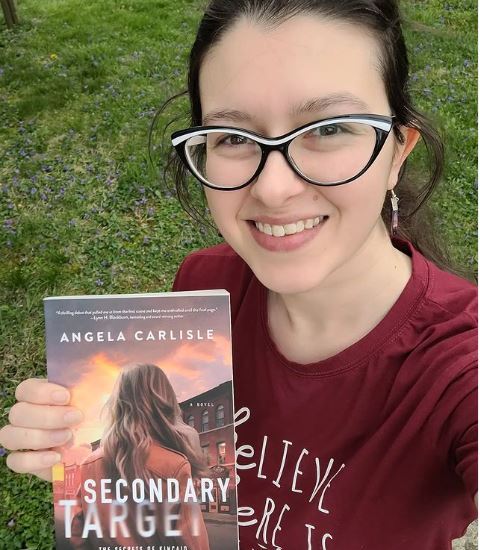
Say hello to debut Christian romantic suspense author Angela Carlisle! I met Angela at a conference a couple of years ago. I was so excited to receive an advance reader copy of her book, Secondary Target, which releases May 2024! I asked Angela to share a bit about her upcoming book.
Secondary Target features a storyline with former boyfriend/girlfriend who are reunited. That’s one of my favorite tropes because it makes the relationship feel well-paced and believable—but it’s not seen as often as some of the others! What’s your favorite romance trope?
Friends to more is one of my favorite romance tropes. As with reunion romances, I feel it can make the romance feel better paced and believable because the characters already know (and like) each other, and it’s a great foundation to build a deeper relationship on.
Houston the faithful dog will be a favorite of pet-lovers who read Secondary Target. Do you have pets, and if so, did any of them inspire Houston’s character?
Houston was so fun to write! I currently only have an outdoor cat that seems to think he’s a dog (it cracks me up when he takes a walk with me in the rain). Although Houston isn’t patterned after any of my previous pets, I totally borrowed the antics of a coworker’s dog to give him some extra personality.
What do you hope readers will take away from your book?
I hope readers will come away from Secondary Target with a reminder of the hope available in Christ. We live in a fallen world, and things are truly dark at times, but for the believer, we don’t have to go through it alone. God is trustworthy, despite our situation and despite our feelings.
I am a huge fan of survival anything–shows, books, true stories. So of course I’m looking forward to romantic suspense author Dana Mentink’s upcoming release, Trapped in Yosemite!
Dana’s joining us today to share about her love of national parks and the inspiration behind Trapped in Yosemite.
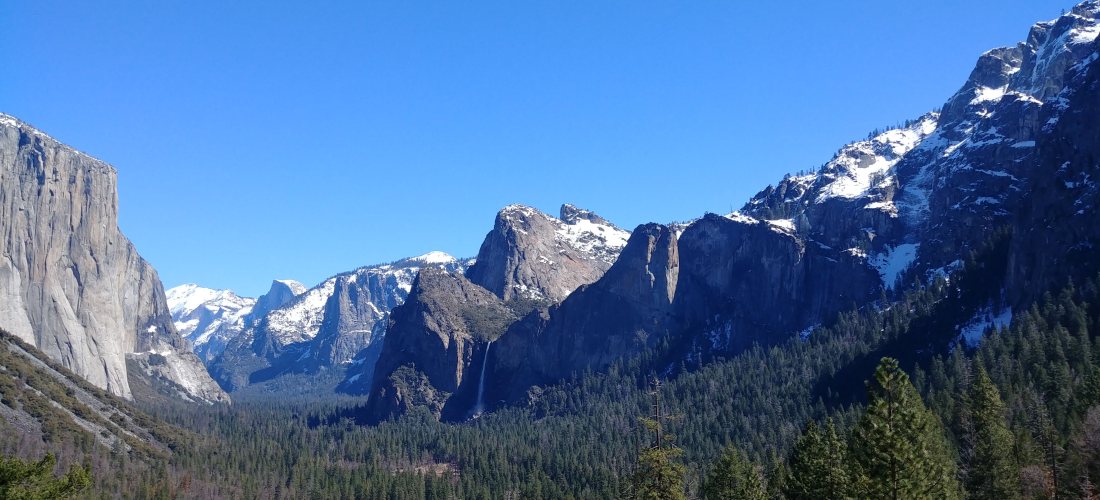
Trapped in Yosemite takes place in one of the West Coast’s most beautiful national parks. I’ve only been once, but I’d love to go back. What is your favorite national park?
Well, Yosemite is definitely at the top of my list. We’ve enjoyed so many amazing trips there and it really is breathtaking no matter what season you arrive.
My favorite park is going to sound like an odd choice, but it’s Death Valley National Park. Definitely NOT a park you can visit all year long, but it’s the most intriguing place I’ve ever experienced. Salt flats, sand dunes, twisted rock formations and canyons, and there’s a surprising amount of wildlife in that hostile place. There’s actually a teeny tiny fish that has only been found in a secluded pool in Death Valley. So incredible!
Your story involves wilderness survival. According to recent polls, most Americans believe they could survive the wilderness for 16 days. Do you think you could?
I would survive for approximately five minutes. Seriously. I live in Northern, California so I’m not weather sturdy. Plus, I am perpetually lost. I can’t even find my car in the mall parking lot. I’d be completely useless in the wilderness, but I would have a snack in my purse so that’s a positive.
As with all of my books, I pray my readers will enjoy a suspenseful thrill ride, encounter characters that resonate with them, and have a gentle reminder of the vast love of our Lord.
Today’s interview guest is fantasy author R.A. Douthitt! I spent this afternoon with my crayons and one of her beautiful coloring books.
You’re the creator of dragon coloring books, dragon picture books, and middle-grade dragon novels. When did dragons first capture your imagination?
When I saw Disney’s The Sleeping Beauty and watched Maleficent transform into that black and purple dragon…wow, I was hooked on dragons forever. I was six years old. I’m 56 now and I still love to draw and write about dragons.
R.A. Douthitt’s latest release–a fantasy coloring book
What inspires the physical and personality characteristics you give your dragons?
I see them as a paradox: They can be hideously ugly or gracefully beautiful. Incredibly fierce yet vulnerable. So, in my stories, that idea inspires how I write their physical and personality characteristics. In my worlds, they are wise, intelligent creatures that desire to live with all creatures in harmony. Yet some are treated cruelly or even trained to be evil. That’s what complicates things!
In my Elves of Vulgaard series, I wanted to show how the Elves can communicate with the dragons and they work with the dragons. In Dragon Games, the main character is a boy who discovers that dragons are being abducted and taken to a mountain prison to fight each other. Kieron works to free them. In Dragon Riders, Everleigh, the main character, earns a spot on the queen’s elite squadron of dragon riders to protect the kingdom. Dragon Sword will be more about the dark wizards who want to enslave dragons again.
In this series, the dragons work with the elves. It’s a clean alternative to some of the dragon book series out there that have sex and violence.
What do you hope people will take away from your books and art?
Inspiration! I hope kids will be inspired to draw and be creative. For those who may not like fantasy, I hope they are inspired to reconsider how they feel about dragons, fairies, and fantasy art in general.
This fall, I had the chance to meet and get to know Carmen Schober, contemporary Christian romance author of After She Fallsand Pretty Little Pieces, releasing in December!
Carmen writes gritty, edgy romance with Cuban-American characters–stories you are not going to want to miss!
I asked Carmen to share a little bit about her writing process for Pretty Little Pieces.
1. The protagonist of Pretty Little Pieces was called the next Joanna Gaines. I’m curious how much HGTV-watching went into the research of this book…and which shows are your favorite?
I used to live on HGTV-style shows! I don’t watch much TV anymore (looking at you, kids) but those shows are perfect for days when you just want something in the background, but you can also get super engrossed and have cozy day-in marathon.
I had a brief Fixer Upper phase, but my absolute favorites are Rehab Addict and While You Were Out (with the OG cast, not the new one.)
2. Naming novel characters (like naming kids) is HARD. You chose really cool names in Pretty Little Pieces. What’s your process? For novel characters and for kids, too!
They honestly just sort of come to me.
But I am a pretty avid Pinterest user and online shopper, so that gives me some good ideas (brands these days often name their products after women) but I usually start with a name that inspires me and then I use Nameberry to find names that sound like they belong in the same world.
Cassidy and Georgina from Pretty Little Pieces
3. Cara Putman’s review on Goodreads called Pretty Little Pieces “A story I kept coming back to because I cared about the characters.” Which character in the story do you love the most, and why?
I really do love Cassidy and Georgina individually and as a couple. Poppy was a joy to write too, and I so relate to Savannah in some ways, but Cass and Georgie stole the show…and my little hopeful romantic heart.
Pretty Little Pieces is the featured novel in my December Wings of the Morning book box. Get yours here! Use coupon BLACKFRIDAY for $5 off all weekend.
Some books have the potential to make your whole year. Over the summer, as an escape from the oppressive Arizona heat, I headed into a Barnes & Noble to browse the fiction section. When I came across a historical romance novel set in Ireland and written by a local author & autographed, I thought, Oh yes, I need this. To be honest, I rarely impulse buy.
Then I posted a picture of my find on Instagram and about died of fangirldom when Jennifer Deibel, the author, commented on my post.
Spending time with Jen (right) and local author friends Sarah, Erin, and Sara
Fast forward several months, and I’ve been lucky enough to call Jen my friend. I’d love for you to meet her, too, and hear about her NEW Irish romance, The Lady of Galway Manor, which will be releasing in February 2022!
Hi Jen! What was your inspiration for The Lady of Galway Manor?
I love the legend of the Claddagh ring, and the tensions between England and Ireland are always coloring things, even today. And I began to wonder what it might be like if a British woman was apprenticed to an Irishman in the jewelry shop. And the story idea grew from there.
As events take a dangerous turn for Annabeth and her family during the war for Irish independence, she begins to see that the bonds of friendship, love, and loyalty are only made stronger when put through the refiner’s fire.
Which character was the most fun to write?
I really love all of them, but I think Seamus—the hero’s father—was my favorite to write. He’s quirky and funny, loves his tea, and is wise beyond his station.
How have you incorporated favorite Irish locations, traditions, or experiences into the book?
Oh yes!! We lived in the Galway area for four years, so I tried to work in some of my favorite places. Some, like the Claddagh area of the city, are the same. Others, like the fish and chip shop, have been changed a little to protect the innocent 😉 and allow me a little more creative license. The jewelry shop itself was also a huge inspiration and still exists and is in business today. But, I changed the name and location in town slightly, again, so I could have a little more creative freedom within the story.
Thanks for stopping by to meet one of my favorite people! I hope you enjoyed getting a glimpse into her writing process and hearing a bit about her own experiences living in Ireland.
If this sounds like a book you’d love to read or gift, you’re in luck! At the time of writing, Baker Book House is offering 30% off The Lady of Galway Manorand 40% off A Dance in Donegal as well as free shipping.
P.S. – If you haven’t heard, Jen and I and a few of our friends are doing a giveaway for book lovers, including a historical romance novel, YA fantasy, middle grade fiction, contemporary romance and bookish goodies! It ends December 4, 2021, so be sure to enter ASAP 🙂
When you get an invitation to go up in a prop plane, you take it.
I recently finished writing a novel manuscript that involves a character making an emergency landing in a small plane. And that’s all I’m going to tell you about it for now—sign up for my newsletter in the sidebar if you want to hear more in the future!
Thanks to the flight elements in my novel, I watched a lot of Youtube and read a lot of content on how to fly a plane.
Turns out, all those buttons and the names of various parts of airplanes are kind of hard to get a handle on when you’re just piddling around online.
So, I wrote the scenes as well as I could and then reached out to John Correia, one of my professors from college who also happens to have his pilot’s license, to see if he’d look it over and make sure I had it right.
Sure, he said. I could do that. Or, I could take you flying.
Um, yes please.
To say I was excited would be a major understatement. I’ve been on a lot of commercial jets, but never in a small aircraft.
The weather was perfect on the day of the flight. I pulled into the parking lot of Flying Cacti at the Glendale Airport and looked around. Not only had I never been on a smaller plane, I’ve never been in a hangar. Actually, I think I might have been in one at Luke’s Airforce Base when I was a kid on a field trip. Obviously I don’t remember enough of that for it to count, though.
Before Takeoff
John opened the hangar door to reveal a blue and white Van’s RV12. Wow! I couldn’t help but run my fingers over the glossy exterior. I could already tell that the glass dome covering the cabin was going to give incredible views, and propeller on the nose just begged to take us for a spin.
John whipped out a checklist to show me all the things he had to check before taking the plane up. It was a long list. As he pointed out, if something goes wrong with your car, you pull over. If something goes wrong with the plane, you fall out of the sky. I had been a little bit nervous at the idea of being way up in the air in a small aircraft, but after seeing how thoroughly everything had to be checked, the trace of nerves I had vanished.
During this process, it was cool to get to ask questions about how the plane worked and what every little thing did. For example, the static ports, two tiny pinholes in what looked to me like screws, use air pressure to give the pilot information about speed and altitude. I never cease to be amazed by engineers and their ability to create and pay attention to all the details. Or to create a flying machine that can carry two people and only weighs about 800 pounds.
Once all the checks were done, John pulled the plane out of the hangar and we climbed in. For my book, I needed to know the steps to start the plane and taxi down the runway, so he talked through everything as he went. When the propeller started whirring into a blur, I could feel it pushing air right into the cabin through the vents that serve as air conditioning.
My heart started beating a little faster. I was in real prop plane, about to go up in the air!
Flying!
John taxied down the runway. We waited for a couple of other planes to take off, and then he powered the plane forward, lifted the nose, and suddenly we were up in the air. Just like that. I felt a huge smile stretching across my face. Wow, the views were way better than they are in a jet with the giant wing slicing through my view out the tiny window. I could see the whole dome of sky above and the earth rapidly falling away below.
We flew above Phoenix Raceway, over the top of the Estrella Mountains, and into farm country I didn’t even know existed behind the mountain range. Below us, brown pinpricks wandered around—cows grazing in the sunshine. The Gila River snaked through the region, feeding the various canals that turn the landscape green despite the desert beige that stretches in all directions beyond the Phoenix area.
In the Air
Since the episode in my story involves a non-towered airport, John took me to Buckeye Airport for a touch-and-go landing, meaning the plane landed on the runway and took off again without stopping. I got to hear all the pilots talking to each other through my headset, communicating in the absence of a tower to coordinate landings and takeoffs.
It’s kind of hard to understand all the different voices through the headsets, which is why pilots use the NATO phonetic alphabet to reduce avoid confusion when they communicate. It sounds like some sort of secret code. Charlie Oscar Oscar Lima!
I had a lot of questions I wanted to ask about the way prop planes work, what would happen if the pilot stopped flying for a couple minutes, how to read the dials on the control panel (although this plane had a screen instead). And I did eventually manage to find the answers to all these things. For a while, though, the scenery and experience was so overwhelming that all I could do was look out the window and take it all in.
Eventually, it was time to head back to Glendale Airport. I searched the landscape for the freeway and the Cardinals stadium to get a sense of location. Wow, we had gone a long way, even though it didn’t feel like it! Back over the Estrellas we went, and soon the landing strip came closer and closer.
Landing the Prop Plane
“Every landing is a crash,” John told me. “The question is, how well are you going to control it? A good landing is one where you can walk away from the plane. A great landing is one where you can fly the plane again.”
Every time I fly, I dread the sensation of touching down. Turbulence doesn’t bother me in the least. Landing? Ugh. Usually, I grip the seat, hold my breath, and tense up in preparation for the jolt of hitting the ground. But I didn’t want to look like a moron while sitting next to a pilot, so I did my best to brace myself invisibly.
The familiar sensation of dropping in a 1000-foot elevator twisted my insides, and then the wheels touched the landing strip . . . and it was fine. I guess there’s a big difference between the feeling of landing in a 400,000-pound jetliner and the feeling of landing in a two-person plane that weighs less than half a ton!
Back at Flying Cacti
John taxied the plane back to the hangar. We rolled past a party in one of the other hangars (the party being nine seniors in lawn chairs) and got a glance at someone’s fancy two-seater, and then we were pulling off the headsets and climbing out of the plane. The owner of Flying Cacti came by for a chat, and one of the employees stopped his truck for a minute to say hi, giving me a sense of the community there.
What an experience! I had always thought of flying a plane as some kind of scary and mysterious process. I figured I had a better shot at getting sprinkled with Neverland fairy dust than grasping the concept of how airplanes move in the air. Although I never took physics (marine biology is way more fun, guys), the basic concept sounds pretty crazy. You’re fighting one of nature’s most basic forces, gravity, by harnessing different forces: thrust and lift.
What I realized from my time in the air is that, yeah, being a pilot takes a lot of skill, from understanding the NATO phonetic alphabet to keeping tabs on all the processes happening inside and outside the plane. But there’s also a sense of wonder to being in the air, controlling a flying machine, seeing the world from a whole new angle. There’s a lot of science involved, but really, science is just another word for magic.
You’re seen the photos on Instagram. Cute desk spaces in neutrals with just a pop of color, an author’s laptop next to a latte in an indie coffee shop, an antique roll-top covered in flickering candles. You know, all those spaces where writing comes naturally, where the novelists and bloggers and bullet journalers sip hot mugs of inspiration while beautiful words flow from their fingertips.
Confession time:
I used to roll my eyes at those photos and pride myself on my ability to write anywhere, anytime, with any level of noise in the background. Busy university library? No problem. Neighbors having a party upstairs? Totally fine. And did I mention my desk looked like this:
Yeahhhhh. Could I write? Sure. But it was not great. In that environment, with my workspace being divided between writing, grad school, and online teaching, I did manage to keep up a busy freelance writing schedule and write my master’s dissertation. But I realized I was also opting to write on my bed a lot, which studies have shown is disruptive to sleep. Or, I’d set up at the kitchen table.
After a while, I realized that there was a connection between my desk looking scattered and my brain feeling scattered. Is that just me? Anyone else?
So then I started trying to set the mood. My writing time started with tea, a snack, and a Youtube music playlist.
But you know what? All that took time, which meant I had to spend effort and precious minutes to get going every time I wanted to write. Because I’m pretty sure my headphones were on an escape mission, and I spent too much time trying to find music I liked, and snack prep is a hobby all on its own.
Then I realized something: if I wanted to write, I needed to put myself in a chair and start typing words.
Environment does matter. But how much did it matter for me? And how much does it matter for you?
Finding a balance
Like everything in life, I think finding a writing environment– or any creating environment– is a balance. I think that atmosphere does matter to an extent. For example, I have a really hard time writing if I can see unfolded laundry from where I am sitting. My brain just jumps into that laundry pile and doesn’t want to come out until all the towels are all lined up in the hall closet. And when I can’t move my mouse very well because I keep bumping up against random piles of clutter, that’s not great, either.
But maybe don’t make a hobby out of curating a writing space. Unless you’re an interior designer. Or that’s what you really enjoy doing in your free time. But definitely don’t fixate on it as a way to procrastinate your writing work.
What works for me is a reasonably tidy desk and a glass of water. (Or a can of Bubly. Give me all the Bubly.) I also prefer to work when other people in the house are either gone or sleeping.
What works for me might not work for you. But here are some ways you can figure out your ideal, productive writing environment:
Declutter Your Desk
Do you need a dedicated writing space? I don’t, even though I have one, but maybe you do. Do you like the background noise of a coffee shop or the mall? Or do you prefer the quiet of your own home?
I think it’s helpful to learn to write in both kinds of spaces, but let’s talk about your own desk. Or table. Or coffee table. Or wherever you have space to write.
The most important part of a desk is that you can fit a laptop on it and sit at it and type. That’s all you need from a desk.
But it’s helpful if clutter isn’t driving you nuts.
One of my favorite bloggers, Rachel Norman from A Mother Far From Home, gave this tip in one of her newsletters: When you see something that needs to be done, just do it. Clean it up. Put it in the sink. File it. And keep a basket in every room where random stuff can go until you have time to put it where it belongs. Then, your space will always feel clean.
So I tried it. Wow. Ok. Mind blown. Maybe my mom was right all those years?
The result? A desk that is always reasonably tidy. At least, it never looks like a file cabinet exploded on top of it anymore. And even better, I no longer have to spend dedicated cleaning sessions for out-of-control pile-ups. Thus, more writing time!
Here’s what my desk looked like this morning, without any prepping for this photo. Not perfect, but definitely clean enough to focus well.
So here’s a question for you: How much clutter is too much for your brain? And how can you make some small lifestyle shifts to keep it at a manageable level?
Design Your Space
Unless you’re doing a lot of Zoom meetings and you need a nice background, this probably a nonessential. I mean, as far as putting pen to paper (metaphorically, of course, unless you’re one of those cool people who still handwrite their stuff), you don’t need your work area to look pretty.
I don’t need my area to be pretty. But I do like my area to look pretty. I didn’t care for a long time, but I think I shot myself in the foot by reading up on color theory and all that. So I added a snake plant, which makes me happy, and a vintage doily from my great-grandma and a couple of candles we had, and voila. Pretty desk.
The wall art is a photo and fabric from the first round-the-world flight. I rescued it from a bulk trash pile!
If you’re really looking for productivity, if you want to finish that novel or write all your wedding thank-you notes or sketch out your memoirs for your kids, then this space is probably not something you should create for the sake of Instagram. You don’t want to spend all your time snapping photos and making reels when you should be writing.
If you like to do those things, don’t do it during your writing time. Block out your writing time and forbid yourself to so much as open your camera app or social media. Don’t water the plants or arrange the accent pieces at all during that time.
So here’s a question for you: Does the aesthetic of your writing space matter to you? What are some ways you can make it a happy place to be? Do you need to set boundaries for yourself so the visual appeal of your desk doesn’t take precedence over your writing?
Decide on Smells and Sounds
Smells and sounds seem to be an important part of the sensory experience of writing. At least if you take Instagram seriously. Come on– who really needs that many candles, Fancy Bookish Writer Lady With An Awesome Antique Inkwell? (Can you read the envy dripping from my laptop?)
But for real. I do find it intimidating when I see pictures of people writing by the light of candles with wax scented like the pages of antique books; in the background, I imagine a tuxedoed violinist drawing forth baroque masterpieces from the strings of his instrument…
The sound of surf and the smell of the sea are my favorite!
And then there’s my house. Which smells like dog and old bananas. Unless the dishwasher is running, under which circumstances the kitchen smells strongly of Drain.
Actually, I have been doing better in the smell department, thanks to my oils diffuser. But I never really pay attention to the smell of my house when I’m writing.
The sounds, now… that used to take up a lot of my time. Searching for headphones, adjusting the volume. Skipping Youtube ads, searching for the right sound on my Amazon playlist. And boy, I can’t stand lyrics when I’m writing! Too distracting… skip that song.
At this point, I’ve just cut out music entirely. I might try again if I am writing an epic scene someday and need some video game music to inspire me. Because seriously. Video game music is amazing.
So here’s a question for you: Do you like to enhance your writing atmosphere with scents and/or music? Is it helpful to you, or is it distracting you from your real purpose: writing? If you want essential oils and a playlist but you find the prep cuts into your writing time, how can you streamline the process?
Plan your Food and Drink
As far as I can tell, there are two sides to problems with writing refreshments. One is getting in a bad habit of eating constantly while writing (hello, M&Ms!) and the other is forgetting to eat. Yeah, I do both.
My excuse for just not eating is that Albert Einstein forgot to eat lunch a lot and therefore it’s a sign of genius. My family would prefer my genius to be less crabby and lethargic.
At some point, I got into a bad routine of starting my work day immediately and not eating pretty much anything until the afternoon, at which point my blood sugar would plummet and I would grab some sugary snack to make it to dinner.
Please don’t tell me I’m an idiot, because I already know that.
Obviously, not eating is bad for your brain and you can’t do your best work if you’re starving. Or even if you’re munching on dry corn flakes all day to stave off hunger.
And substituting junk food is also not great, especially if you’re like me and feel like crap when you eat sugar or caffeine.
Having a child forced me to follow a better meal routine, thankfully. But I still have a lot of days when I don’t eat lunch and then snack on weird stuff in the afternoon while I write (stale marshmallows, anyone?).
What I find works for me is making myself a healthy meal and eating that while I write. Because I am going to write. I may or may not eat. So if I’m doing both at the same time, at least I won’t be a hangry monster by the time my husband gets home.
The flip side of not eating at all is snacking too much while writing. Which I also do a lot, a habit that started when I was trying to stop biting my nails (didn’t work, by the way).
I find that chewing gum helps, or having something without too much sugar to sip on, or making a air-popped popcorn to substitute for skittles. Actually, silly putty and other tactile toys can help, too, if the problem is being super kinesthetic and just needing something to fidget with in order to focus.
And then, of course, there’s the need to have a drink on hand while writing. I’m not a coffee drinker, so I don’t really get the whole coffee-lover thing.
I know, I know. Coffee is life. It flows in your veins. We can’t be friends anymore because I don’t drink coffee.
For whatever reason, I have better writing focus when I have something to drink. I like sparkling water or tea when I write. Fancy Starbucks frappes are also on my list of favorite writing companions. And obviously drinking water all day every day is good for the brain!
In my experience, the best way to eat or drink when writing is to plan what I’m going to have in advance. Then, I’m not hungry or thirsty, I’m not hopping up to go hunt through the pantry when I should be writing a scene, and I’m not sitting there thinking, “Ok, how many pieces of licorice did I just eat? I need to stop. I really need to stop.” I’m thinking about writing. Like I want to be.
So here’s a question for you: What are your food and drink habits while you write? Do they make you feel crappy? Do they distract you from writing? Do you need to create a better routine that will help you get more done and feel better in the process?
Here’s What It Comes Down To…
The point of writing is to write. Right?
I’ve found it’s good to assess what I’m doing every now and then to see if it’s working. Strip it down and see what I miss. See what is better off gone.
If you’re a writer, or a student, or a creator, or work a desk job, or whatever, why not assess this for yourself? What habits make you sharper, more productive? What makes you frustrated, slows you down, distracts you?
Everyone is different. Find what works for you, and do it. Do what helps you sit down. Open your laptop. And write.



 Breana Johnson