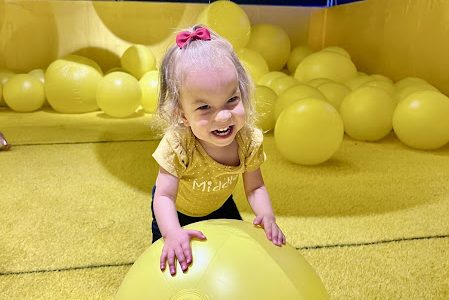
When my daughter was first diagnosed with a rare genetic condition, my response was, “Why me?”
There are only 50-100 people living on planet earth with this condition. Why did my child have to be one of them? Why her? Why us?
I’ve been offered various answers to this question by people around me or just the good citizens of the internet. You know: God gives special kids to special people. It’s because you’re a good person. It’s because God knew you could handle it.
I don’t like those responses, and I don’t think they’re theologically sound anyway.
(At the same time, I know that it can be hard to know what to say when discussing disability diagnoses, and people say these things to express “I care what you’re going through. You’re going to be OK.”)
At the moment, I tend to think that disability just happens sometimes, and that’s that. I don’t think God causes it but, but rather allows it. I might be wrong, of course. But what matters most to me is that he’s aware that somewhere in my daughter’s early development, a chromosome created an extra copy. He wasn’t caught off guard by it. He sees me and he gives me the grace to walk through each day.
As I began my disability parenting journey, I asked a friend whose daughter also has special needs if I was ever going to be OK again. She told me that once she came to terms with what the disability parenting meant for her own life and future, she found that she was able to accept the situation and be OK.
I found this to be true as well. Once in a while it occurs to me that if I wasn’t running around to therapy and doctor appointments all the time, I’d be able to invest in my friendships more. But overall, these appointments have become the normal and accepted rhythm of my life. It also no longer bothers me that my child is far behind her peers. She is who she is, and we love her. And it no longer bothers me that I will never be an empty nester. My husband and I have built new dreams for that season of life, and they include my daughter.
I still ask, “Why me? Why her?” But not in the same context. My girl is delayed for sure, but she’s progressed beyond our wildest dreams. She consistently surprises her therapists and doctors. She has physical skills that should be impossible. She is far healthier than anyone thought she’d be.
Most kids with my daughter’s condition don’t walk at age two. I ask, “Why me? Why her?” Why is mobility a years-long struggle for other families, and not us?
Most kids with my daughter’s condition need a feeding tube during their first years of life, and maybe forever. My daughter has never had one. I ask, “Why me? Why her?” as I see families in our Facebook group fight to transition to oral feeding.
I don’t understand why my daughter has to live with a severe disability. I also don’t understand why she is able to enjoy a level of autonomy and health that other kids like her don’t have.
Maybe the simple answer is that life is not fair.
But a wiser thought comes from C.S. Lewis in this section of The Chronicles of Narnia:
“Child,” said the Voice, “I am telling you your story, not hers. I tell no one any story but his own.”
“Who are you?” asked Shasta.
“Myself,” said the Voice, very deep and low so that the earth shook: and again “Myself,” loud and clear and gay: and then the third time “Myself,” whispered so softly you could hardly hear it, and yet it seemed to come from all around you as if the leaves rustled with it.
Shasta was no longer afraid that the Voice belonged to something that would eat him, nor that it was the voice of a ghost. But a new and different sort of trembling came over him. Yet he felt glad too.
 Breana Johnson