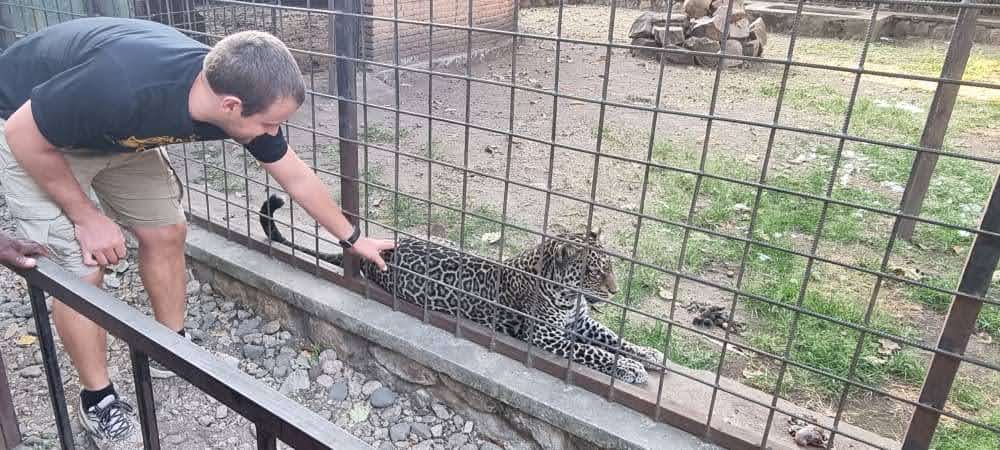
Have you ever wanted to pet a leopard? What about cuddle a chimp? Or feed a crocodile? Well, if you ever find yourself at Musee Vivant in Burundi, you can do all of those things.
While we were in Bujumbura, Burundi, my brother-in-law and sister-in-law took us and their kids to the local zoo, which features animals from East Africa.
Bujumbura’s zoo, Musee Vivant (“Living Museum”), doesn’t have the red tape or safety precautions of zoos in the States.
Part of that is really fun–nobody at a zoo in the U.S. would allow you to pet a big cat with gigantic fangs.
It also means that you do have to use your own common sense to decide what is or is not a good idea…like maybe if you’re wearing a ponytail, don’t snuggle the baby chimp. If it gets curious and yanks on your hair–well, there goes your scalp and your face.
Fortunately, my nephews don’t have ponytails.
As you can see, there’s a good reason why my sister-in-law calls this “The Petting Zoo of Things That Should Not be Petted.”
The Musee Vivant also offers a cultural element. Our tour guide took us through an exhibit showing recreating a traditional Burundian elder’s home.
There are several of these houses clustered together. One big house would be for the elder, and each of his wives would have a smaller version.
Our three-year-old wasn’t actually that impressed by the animals in the zoo–he’s not much of a predator person and I wasn’t too keen on letting him watch the crocodile hunt down a live guinea pig, anyway. He was more interested in finding sticks and drawing in the dirt with Auntie Joy.
But he did love walking through the houses and trying to climb this gigantic kapok tree with his cousins.
What about you? Which animals would you pet? And would you climb that tree? Let me know in the comments!
A Christian fantasy series based on adventure board games? Yes, please! Today I had the priveledge of talking to James R. Hannibal, author of the Lightraiders Academytrilogy. The second book in the series, Bear Knight, released in February of 2023 from Enclave.
How has your background contributed to the action scenes in Bear Knight?
I’m always aware of the physics when writing action, whether hand to hand combat or aerial battle.
Having studied multiple martial arts and having trained US troops in hand to hand combat certainly helps with the fight scenes. Having flown fighter and bomber aircraft also helps with visualizing the aerial scenes. Of course, everything must be adjusted for the physics of the fantasy realm.
Bear Knight has some awesome maps! How do you come up with the landscapes you invent?
I had a great foundation to start with. The Lightraiders Realm was first created by Navigators author and Christian counselor Dick Wulf back in the 80s. When he handed the world to me, I had a fairly detailed world map to start with and a few towns or locations that were created for the original game. That became my palette from which to build out other locations and fill in the map.
From there, I develop a landscape or village in my head and then work with fantastic artists and cartographers like James R. Brown and Jog Brogzin to bring them into visual reality for a reference.
What books or series inspired your love of fantasy?
This entire series is based on the original DragonRaid game by Dick Wulf. Our team is grateful he had the opportunity to write the forward for Wolf Soldier, the first book in the series, before he went on to be with the Lord. Both Dick and I have been inspired by Tolkien and Lewis primarily.
What do you hope readers will come away with after reading Bear Knight?
The theme in Bear Knight is courage in the face of our fears. We’re talking about fear of physical danger as well as less tangible but just as frightening fears. The characters deal with fear of being left behind by peers, fear of failure, fear of becoming someone they don’t want to be, etc.
I hope that readers learn that no matter what fears they face, they can always find peace and hope in Christ and His promises, and thus the courage to face those fears head-on.
That’s just an economic measure, of course. It’s not a measure of natural resources, happiness, overall wellbeing, social health, satisfaction with one’s life, etc. Money’s not everything. But it does impact access to healthcare as well as the ability of people to pursue higher education that would lead to more nationals becoming healthcare professionals.
The long drive across Burundi
With a lack of access to healthcare, particularly in rural regions, many people suffer devastation from easily-treated diseases like malaria.
We’ve seen this happen even to our own family members, who, as expats with cars and insurance for medical evacuation, have far more access to medical treatment.
If you’ve been following our story for a while, you may have read about Ben’s near-death experiences growing up in sub-Saharan Africa.
Part of the reason for our trip to Africa was to tour hospitals and visit with doctors–both expat and national– to ask questions and see where Ben might be able to fit in the future, when we’ve paid off the student loans and are in a position to do medical ministry overseas.
Playing on a African hospital’s compound. In the background, Ben meeting with doctors from this hospital.
Planning to move overseas is complicated.
Hoping to do medical work is even more so. There are a lot of questions to consider.
What hospital/clinic has needs we can fill?
What sending organization do we go with?
Where will our family fit in?
Do we work for an international NGO or a local-run institution?
How much change can we handle right off the bat?
Will our kids be OK here? (This is the one that really weighs on my mind)
Expat doctors live and work on this compound
We came away with a lot of great options. Still, we have a lot of unanswered questions. That’s OK, because we have a lot of unpaid debt, too, so we have some time to figure out the best fit for us when we’re able to go overseas.
We haven’t taken meaningful steps toward moving yet, and James 4:14-15 is always in the back of my head when I talk about our hopes for the future.
Still, we get asked all the time: Why? Why would you want to give up your life in America and move somewhere like Burundi?
The surface-level answer is that Ben is from there. It is home. It was the plan all along and the only reason that Ben had any interest in slogging through eleven years of medical training.
The deeper answer is that Jesus is worth it.
I’ve discovered that answer is a great testimony to our faith and God’s glory. People can argue with your apologetics. But not with your personal experience of Jesus’ worthiness and your willingness to press into that with your own life decisions.
Why struggle on with a difficult season in marriage? Jesus is worth it. Why become a foster parent? Jesus is worth it. Why forgive the family member who hurt you deeply? Jesus is worth it. Why choose a career walking alongside hurting people? Jesus is worth it.
Friends, I don’t know what choices you’re making or what seasons you’re walking through. But I pray that wherever you’re choosing obedience to Christ, you’ll have the chance to give his name glory by telling others that Jesus is worth it.
It’s that time of year! Yes, Christmas time–but also book giveaway time! You can enter the annual 12 Days of Christmas Giveaway here between today and December 12. And entries roll over, so the earlier you enter, the more days you’ll be entered to win!
This fall, I had the chance to meet and get to know Carmen Schober, contemporary Christian romance author of After She Fallsand Pretty Little Pieces, releasing in December!
Carmen writes gritty, edgy romance with Cuban-American characters–stories you are not going to want to miss!
I asked Carmen to share a little bit about her writing process for Pretty Little Pieces.
1. The protagonist of Pretty Little Pieces was called the next Joanna Gaines. I’m curious how much HGTV-watching went into the research of this book…and which shows are your favorite?Â
I used to live on HGTV-style shows! I don’t watch much TV anymore (looking at you, kids) but those shows are perfect for days when you just want something in the background, but you can also get super engrossed and have cozy day-in marathon.
I had a brief Fixer Upper phase, but my absolute favorites are Rehab Addict and While You Were Out (with the OG cast, not the new one.)
2. Naming novel characters (like naming kids) is HARD. You chose really cool names in Pretty Little Pieces. What’s your process? For novel characters and for kids, too!
They honestly just sort of come to me.
But I am a pretty avid Pinterest user and online shopper, so that gives me some good ideas (brands these days often name their products after women) but I usually start with a name that inspires me and then I use Nameberry to find names that sound like they belong in the same world.Â
Cassidy and Georgina from Pretty Little Pieces
3. Cara Putman’s review on Goodreads called Pretty Little Pieces “A story I kept coming back to because I cared about the characters.” Which character in the story do you love the most, and why?
I really do love Cassidy and Georgina individually and as a couple. Poppy was a joy to write too, and I so relate to Savannah in some ways, but Cass and Georgie stole the show…and my little hopeful romantic heart.
Pretty Little Pieces is the featured novel in my December Wings of the Morning book box. Get yours here! Use coupon BLACKFRIDAY for $5 off all weekend.
Mama Violette crafts these baskets using what my 11-year-old niece calls “goat rope” (rope made of fibers processed from sisal, a yucca-like plant), grass that grows near the river, and the plastic fiber from coffee sacks.
I asked Mama Violette where she learned to make these baskets. I expected a heartwarming answer about sitting long afternoons with her grandmother. However, she told me that she learned during her time in a refugee camp while Burundi was suffering through a civil war.
She takes apart the sacks and straightens the fibers. Most of them are white, but colorful plastic is also available for designs. The durable, waterproof plastic replaces traditional organic materials in most baskets I saw.
Recycling at its finest!
Mama Debo helped teach us to weave the baskets.
The basket starts with an inch or so of wrapping the plastic around the rope and grass. Coil the plastic-wrapped rope, thread the plastic through a needle, and stich the coil in place.
The rest of the basket is pretty simple–keep wrapping, putting a stitch through the last round each time. I noticed that Mama Debo and Mama Violette placed one stich evenly though each wrap on the coil below.
Making a basket takes a lot of time–a full day even for someone experienced. Later during our trip, I purchased a few small baskets from a roadside stand.
Can you guess how much one costs?
Two dollars. That’s all these women make from a day of hard work. That’s a typical wage for people in rural Burundi.
Mine wasn’t quite so neat, but it looked a lot better than my first attempt at a coil basket, which I tried to make with agave fibers from a plant in my yard. If you want to take a peek and laugh, visit this post.
One of my nieces added some color to her basket. I was endlessly impressed by her creativity and knack for crafting. Aside from her new skill of basketry, she actually processes “goat rope” from sisal herself, dyes it using natural pigments she makes from nature, and weaves them into bracelets.
Making a full basket would take a beginner like me days–even this little bit was the result of a couple of hours of work. So I decided to stop and turn it into a keychain.
Mama Violette helped me finish it off.
She and Mama Debo inspected my work, saying “Ni sawa.” I thought that meant I had not a fantastic job, but apparently it means. “That’s alright.” Hey, for a first attempt, I’ll take it!
Now, I carry around this little souvenir on my keys wherever I go!
However, my main takeaway from this project wasn’t a physical item, or even a new skill.
Even though I couldn’t have a conversation with Mama Debo or Mama Violette, they were content to sit on the porch with me and communicate however we needed to, patiently helping me learn each step of basketmaking. Despite the many differences in our lifestyles, experiences, and backgrounds, they did not make me feel like an outsider.
Instead, we enjoyed a project together, connecting over a shared interest.
No matter the differences between us, we have more in common than we might think.
Who knew you could meet an author in an elevator and end up being a huge fan of their books? Well, that’s exactly what happened to me when I ran into Ashley Clark at the ACFW conference this year.
I read her book Where the Last Rose Blooms in a single sitting. It was that good.
So I thought I’d invite Ashley to do an interview here so we can share this book with you and talk about some of the little-known historical facts behind its plot and characters!
Did you notice that her dress matches the dress on the book cover??
Hi Ashley! Thanks so much for taking the time to answer some questions.
Thank you so much for having me, Breana! It was such fun to meet you at the ACFW Conference. I’m looking forward to chatting on the blog today.
I learned a lot about the messages of various flowers in Where the Last Rose Blooms. I had no idea a bouquet can actually be a secret code–which is exactly what ends up happening in your story!
What is your favorite flower, and what is the meaning behind it?
I had a great time researching flowers for Where the Last Rose Blooms, and I have to confess… I even bought my own flower dictionary!
Honestly, I love all flowers, but if forced to pick a favorite I’d probably choose peonies. I think their intricate petals are so stunning. They typically symbolize love, romance, and beauty, which makes them the perfect flower for weddings! Alice in Where the Last Rose Blooms probably sells a lot of them. 🙂
You named one of your characters “Ashley,” which was very Jane Austen of you. What’s the story behind giving a character the same name as yourself?
I am so glad you asked about Ashley’s character because there is a story behind this one!
Rose and Ashley are actually based on real people, who were named… you guessed it… Rose and Ashley!
History has left us very little information about their stories, but we do know a bit from the Ashley’s Sack artifact which was discovered at a flea market and is now on display at the National Museum of African American History and Culture in D.C. I hope to see it in person someday!
Ashley’s cutting of the Peggy Martin Rose, which survived being underwater during Hurricane Katrina and plays a role in Where the Last Rose Blooms
I enjoy a good fictional romance, but it’s also fun to hear the love stories of real-life couples! Would you share yours?
My husband and I met in college at our campus ministry. He invited me to Starbucks after a prayer event, and I initially told him no because I needed to study… on a Saturday.
Y’all, I was such a nerd back then!
Okay, I’m still a nerd, but I digress… needless to say, he talked me into the shindig, and I remember calling my mom that night and telling her one of the “cool guys” had invited me to coffee. Ha!
He bravely learned to swing dance in the weeks that followed because he knew I used to dance every Friday night, but the real kicker was one rainy night at Steak and Shake… he pulled his car up close to the door so I wouldn’t get wet, and “coincidentally” had Switchfoot playing on his car radio. I think his great taste in music sealed the deal for me. Hahaha!
We’ve now been married thirteen years and have a seven year old son, as well as a senior cocker spaniel.
I hope you enjoyed getting to know Ashley as much as I did! If you want to know more about her books and flowers, you can follow her on Instagram or visit her website.
While we were having fun feeding goats and pigs, dozens of people were hard at work building bricks for the livestock project’s new building. The method used is basically the same as what you’d see in the Middle East or in pueblo ruins near my home in Arizona.
Making mudbricks at home in Arizona
I’ve made mudbricks before. The materials are cheap, but the labor is hard.
Here’s how to make mudbricks Africa style:
Saturate the dirt and mix it (usually with feet or a hoe) until it’s the right consistency.
Fill brick molds with mud and smooth it.
Wait for it to dry (a long, long time! I’ve heard it can take months).
Stack the bricks into a kiln and fire them.
Construct a building.
School was out for the summer, so there were a lot of kids helping. Summer vacation is not time for play in East Africa.
You might see women carrying bricks on their heads…I can’t imagine having that kind of strength!
There’s a story missionaries like to tell about a doctor whose patient had thrown out his back. “How did it happen?” the doctor asked. “Oh, I was helping my wife get a load on her head,” the patient replied.
I don’t know if it’s true, but I wouldn’t be surprised. Burundi’s culture celebrates work ethic, and you don’t have to look far to see people who embody that value.
I recently wrote about attending a dowry ceremony in Burundi. My whole family was invited to attend the wedding the next day, even though we did not know the couple and were visiting from the U.S.
Yes, we did color coordinate our clothes. Photo credit: Danny J.
The wedding took place in a the couple’s church, a beautiful brick building shaped like a heart. It included performances by the choir and speeches with advice to the bride and groom. My family doesn’t speak Kirundi, but my sister-in-law whispered an English translation to us. The service also had a sign language interpreter for Deaf guests, and I could understand most of that.
Kirundi word of the day: Kaze (Welcome)
The couple prepares to be presented as man and wife.
According to the local tradition, asking someone to act as best man and matron of honor is also a request for lifelong mentorship and marriage counseling. The older friends who stood in this role for the newlyweds have a reputation for a stable, loving marriage despite challenging life circumstances.
Hospitality is a strong value in Burundi, and we were offered seats of honor with the groom’s family during the reception. This accomplished the need to have someone stand in for the groom’s extended family members who couldn’t make it as well as the need to express a welcome to out-of-town guests.
I had another role, too. My sister-in-law made the wedding cake, and I had the job of walking up the aisle to deliver it to the couple!
A toast with Fanta Orange
It was quite an experience to see how Burundian weddings are done and to be able to appreciate the meaningful customs they observe. Getting invited to anyone’s wedding is an honor, and I always love having the chance to witness one of the most important moments of a couple’s life.
If you want to experience a traditional East African lifestyle, rural Burundi is a good place to go. You won’t have pavement or electricity or running water, but you will have the chance to discover local agriculture and artistry. Welcome to Gisuru, a small farming town deep in the hills.
While we were in Africa, my sister-in-law Annie, who lives in Gisuru, invited me to come with her to a Burundian dowry ceremony. This event happens shortly before a wedding, and it entails a dinner and a reception with the exchanging of gifts/bride, speeches, and a lot of soda.
Annie lent me a traditional dress. Photo credit: Danny J.
It’s Africa, so we expected the event to start late. We arrived two hours late and then waited an extra hour. I was in the car with Annie and four Burundians, and they taught me some Kirundi words in the meantime.
Carrying – you guessed it! – cases of soda. Photo credit: Abel N.
Kirundi word of the day: Fanta/soda. (Soda of any brand. Also a euphemism for “bribe,” so if someone asks for a “soda” they probably want money in exchange for a favor.)
Dinner was delicious—chicken, beef, rice, cabbage, and fried potatoes. We sat with the groom’s family, as we’d been asked to stand in for extended family members who couldn’t make it.
Carrying gifts to the dowry ceremony. Photo credit: Abel N.
Some of the events:
Dinner
Sodas
Traditional speeches: representative of the bride’s family takes turns with the groom’s representatives to publicly discuss the culmination of their bride price arrangements.
The family reiterates their acceptance of the terms and gifts arrive (more sodas, in this case).
The bride arrives with an entourage and the women vocalize their joy.
The brothers of the bride block the groom’s path to her until he gives them a gift.
Together, the two families sip a banana drink from a big bowl with straws.
The bride gives the groom a gift—new shoes.
The bride gives gifts to the parents.
More speeches.
More sodas.
More speeches.
More sodas.
The bride gave her groom new shoes. Annie and I sitting with the groom’s family. Photo credit: Abel N.
It was a big day for the bride and groom. And the next day would be even bigger: their wedding day!