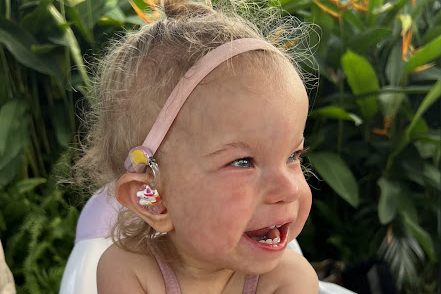
My daughter’s audiologist sat across the table from us as we waited to retrieve our two-year-old after her two minor surgeries and sedated hearing test.
“Well, the results of the hearing test are very different than they were last time.” The audiologist glanced at her assistant.
I shrugged. “They always are.” This was the fourth BAER hearing test my girl had undergone in two different hospital systems by four different audiologists. Each time, the chart mapping her hearing looked different, thanks to the fluctuation of fluid trapped behind her eardrums.
“Actually, she must have been misdiagnosed before,” the audiologist said. “Previously, the tests revealed mixed sensorineural and conductive hearing loss.”
“Right,” I agreed. We’d grappled with this diagnosis in a list of rare diagnoses. Not only does my daughter have an incredibly uncommon genetic condition, but she also was diagnosed with two types of hearing loss at the same time. Conductive, which can be due to a variety of factors, many of them correctable, as well as sensorineural, which has to do with irreversible issues with the cochlea and/or nerves.
The audiologist cleared her throat. “Well, this time, the test showed only conductive hearing loss. She doesn’t have sensorineural hearing loss after all.”
I exchanged a look with my husband, who raised his eyebrows. “But how?” I asked. “How did she get a false positive for sensorineural issues three times?”
The audiologist shook her head. “It happens. It’s hard to get the placement of the electrodes right on babies. If you’re a quarter of an inch off, it can give a false positive.”
“So what does that mean for our daughter?” My husband asked.
The audiologist shrugged. “We’ll have to see, but conductive loss isn’t always permanent. So she may gain hearing as she develops. And overall, she can hear better than prior tests showed.”
I thought back to when my daughter, then a newborn, had failed her hearing screenings, received a sedated test, and been diagnosed with moderate-severe hearing loss in both ears.
“I’m praying that she will be able to hear,” someone at church had told me when I shared the news. I smiled politely, too weary to try to explain that this type of diagnosis could never go away.
For the next two years, I believed my daughter would never hear the sounds that I took for granted. And at first, that didn’t seem so bad. I’d flitted along the edges of the Deaf community for years, learning ASL and dipping my toe into the depths of Deaf culture. Seeing their sense of community and identity, I had thought I’d have perfect acceptance on the off-chance that a child of mine was born deaf.
But layered with her cognitive, fine-motor, and communication delays, I quickly realized that being hard of hearing wasn’t going to be a cultural identity for my daughter, but rather a major hindrance to her ability to learn to interact. I longed to wield auditory input as a tool in our agonizing battle to help her reach each tiny milestone.
And now, all these months later, my wish and my friend’s prayer had been answered.
When the audiologist left the room, my husband and I stared at each other. Had we witnessed a miracle? Jesus healed many deaf people in scripture; had he whispered ephphatha, be opened, to my little girl as well?
In his new documentary The Case for Miracles, author Lee Strobel says that he’s hesitant to give credence to claims of miracles that can be explained in any way by medicine or science. I have to say that I’m a skeptic, too. I’ve heard too many improbable stories of miraculous healings that ended up being bogus. And sometimes we just don’t understand the inner workings of the human body. If the audiologist believes that my daughters original diagnosis could be explained by improper electrode placement three times in a row, well, that’s the most reasonable answer.
I think God can grant a person their hearing in miraculous ways, but I don’t think it’s any less beautiful or amazing for him to do it through the skill of a surgeon or an accurate test result. Either way, we received an incredible answer to prayer, and I am thankful for that–and for those who have faith to pray for the impossible.
 Breana Johnson
Wow,Breana! This is such good news! God is good and He is great! I’m so happy to hear this! NancyAnderson
LikeLike
That is awesome!
LikeLike
Thank you Breana for sharing this story! God is great!
LikeLike
Breana, What a beautiful miracle that was! I truly believe that God has answered prayers and performed a mighty miracle. He is able!
Joy Wolfe
LikeLike
What wonderful news. Briana is a beautiful child. God Bless Briana. We will keep Briana in our prayers for continued healing.
Marion and Marilyn
LikeLike
Praise the Lord!
LikeLike
We absolutely believe in miracles. God is still a Healer 🙌🏼 we are praising the Lord with you all.
LikeLike